Crowns · bridges · bonding · fillings
A bridge is three things, and you pay for all three.
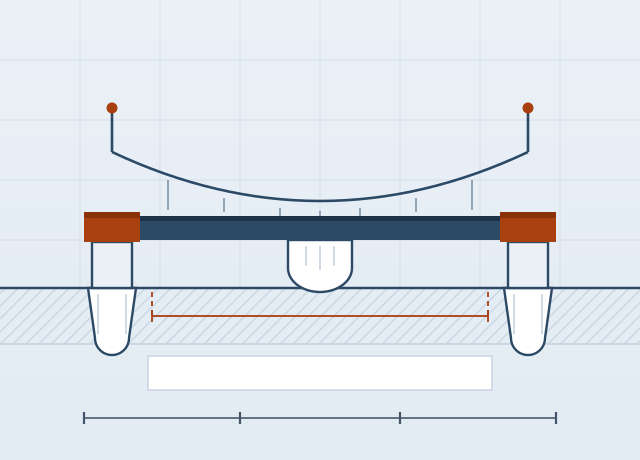
Crowns, bridges, bonding and fillings, costed from three published payer fee schedules — every figure with the document it came from and the day we read it. No national average, because nobody publishes one.
Three published schedules · every figure dated · not reviewed by a dentist
Where the numbers come from
No free, public document publishes what a private US practice charges for a crown. These three do publish what somebody actually pays a dentist — so every figure on this site is traced to one of them, with the date on the document and the day we read it.
Pennsylvania
Medical Assistance Program Dental Fee Schedule (Pennsylvania Department of Human Services)
a state Medicaid programme. Schedule effective 1 August 2026; read 24 September 2026.
Montana
Montana Healthcare Programs Fee Schedule — Dental Services
a state Medicaid programme. Schedule schedule dated 1 January 2026; these lines carry an effective date of 1 July 2025; read 24 September 2026.
Washington
Washington State Department of Health, HIV Early Intervention Program — Schedule of Dental Coverage and Maximum Allowances (DOH 410-079)
a state public-health programme, capped at $3,000 per client per calendar year. Schedule allowances valid 1 April 2026 to 31 March 2027; read 24 September 2026.
The workbook
All sheets →A crown has come off: what it costs to have it put back, and why we will not tell you how to glue it
Re-cementing a crown is allowed between $25.00 and $59.28 on the three schedules we read. It is one of the cheapest things in restorative dentistry, and it is not a job for a kitchen table.
Read the sheet →Sheet 02 · checked Sep 24, 2026What dental bonding costs — and why no fee schedule has a line called bonding
Bonding is a technique, not a billing category. On the schedules it appears as a composite restoration priced by how many surfaces of the tooth it covers — from $50.00 to $227.00.
Read the sheet →Sheet 03 · checked Sep 24, 2026Bonding for gaps and chipped teeth: what composite can do, and what a photograph cannot tell you
Closing a gap and rebuilding a chipped corner are the two jobs people most often want bonding for. Here is how each is billed, why the same work can be funded or not, and how to read the pictures.
Read the sheet →Sheet 04 · checked Sep 24, 2026Dental bridge before and after: what the photographs leave out
The pictures show a gap and then no gap. What they cannot show is the two teeth that were cut down to make it happen, the stages in between, or what the plan is when it needs redoing.
Read the sheet →Sheet 05 · checked Sep 24, 2026Traditional, cantilever and Maryland bridges — what each asks of the teeth beside the gap
Three ways to hang a false tooth from its neighbours, and one uncomfortable pattern: the less tooth a bridge destroys, the less likely a payer is to have a line for it at all.
Read the sheet →Sheet 06 · checked Sep 24, 2026The codes on your dental bill: what the shape of the billing tells you
Every restoration on a treatment plan is a code with a fee beside it. You do not need the code book to read one — you need to know how the lines are counted, and which ones are hiding elsewhere.
Read the sheet →Why this site prints schedules instead of averages
Search for the cost of a crown and you will be handed a range within seconds. Follow that range back and it usually ends nowhere — a survey behind a paywall, a marketing page, or another site quoting a third. We looked for a free, primary, public document giving a United States retail price for a crown, a bridge, bonding or a filling on 24 September 2026, and did not find one. So we stopped looking for an average and started reading fee schedules.
A fee schedule is a published list of what a payer allows a dentist for a defined procedure. It is not a shop price, and this site never calls it one. It is something better for a reader trying to judge a quote: a real number, attached to a named document, with a date on it, that anyone can open and check. Three of them are read in full here, and everything on the site is traced back to one of them.
The finding that shaped the whole site
One all-ceramic crown, one procedure code, three published allowances: $500.00, $790.40 and $1,028.00. Nothing clinical separates them. The lowest and the highest differ by just over two times, and both are documents you can download today. That spread is the reason an honest site cannot give you one number — and the reason it can still give you something useful, which is the full crown table with every type in it.
What is not here
No dentist reviews this site, and no page pretends otherwise. No practice, chain or group is named, ranked or linked anywhere on it. There are no before-and-after photographs, no patient stories and no success rates, because we could not source any of them honestly and an invented one reads exactly like a real one. There is no quote form, because a form that knows nothing about your tooth cannot produce a number and a form that collects dental details deserves a lawyer we do not have.
What is here is arithmetic you can check, sources you can open, and an honest account of who pays us and what we turned down.